Why You Need One API Key for All Models in Your AI Workflow
Working with multiple AI models from different providers quickly becomes a logistical headache. Each model family has its own authentication scheme, rate limits, SDK quirks, and billing cycle. Developers end up writing adapters, managing several API keys, and tracking usage across separate dashboards. The promise of using the best model for each task gets buried under integration overhead.
A simpler approach is gaining traction: using a single API key that routes requests to many models. The idea is not just convenience. It changes how you evaluate, test, and deploy AI features. Instead of committing to one provider upfront, you can compare outputs side by side and switch models as your needs evolve. This flexibility matters more as the landscape of available models keeps expanding. UberLLM one api key for all models
The Hidden Cost of Multiple API Keys
Every API key you manage adds a small but real cost. There is the initial setup time, the ongoing maintenance of authentication logic, and the mental overhead of remembering which key goes with which service. When a key expires or a provider changes its endpoint, you have to update configuration files, environment variables, and possibly redeploy code. For a team running several models, these small frictions add up to lost development time.
Beyond the operational side, multiple keys make it harder to compare models objectively. You might run GPT-4 through one key and Claude 3 through another, but you cannot easily route the same prompt to both without writing custom logic. That lack of parity means you might stick with a familiar model instead of testing alternatives. Over time, your application drifts from the best available option.
How a Unified API Key Changes the Workflow
When you have one API key for all models, the authentication layer becomes invisible. Your code sends a request with that single key, and the platform routes it to the model you specified. If you want to switch from GPT-4 to Gemini or Llama 3, you change the model name in your request, not the credentials. This makes A/B testing practical. You can send the same prompt to two models and compare responses without touching your infrastructure.
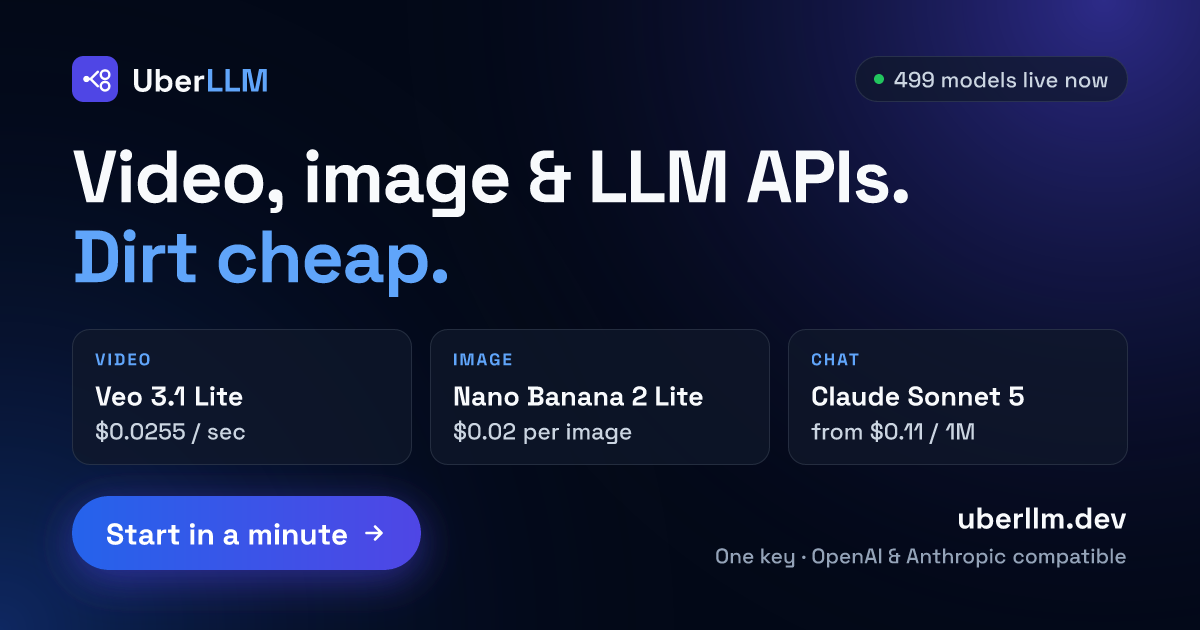
The UberLLM one api key for all models approach takes this further by adding a marketplace layer. Instead of paying fixed retail prices for each model, you access competitive pricing through multiple sellers. The platform handles the routing and billing so you only need to track one key and one invoice. This is especially useful for teams that consume large volumes of API calls across different models. The setup time for a new model drops from hours to minutes.
Practical Considerations When Choosing a Unified Key Provider
Not all unified API services are equal. Here are a few factors to weigh before committing to one:
- Model coverage, Does the service support the models you actually need? Some platforms focus on popular chat models, while others include embeddings, image generation, or code completion models. Make a list of your current and likely future models.
- Latency and reliability, Adding a routing layer introduces a small overhead. Look for services with transparent uptime stats and low added latency. If your application is latency-sensitive, test the response times under realistic load.
- Data handling and privacy, Check whether the platform logs your prompts or responses. Some enterprises need guarantees that data stays within certain regions or is not used for training. Read the terms carefully.
- Pricing model, Unified keys often come with either a markup on each call or a subscription fee. Calculate your expected volume and compare it with direct provider pricing. The convenience might be worth a small premium, but you should know the numbers.
One common mistake is assuming that a unified key automatically gives you the lowest price. In practice, the platform's routing and seller competition can lower costs, but you should verify that for your specific usage patterns. The UberLLM one api key for all models model uses competitive seller routing, which can drive prices below typical list rates, but your mileage depends on the models you use and the sellers available at the moment.
When a Single API Key Might Not Be Enough
There are cases where managing separate keys still makes sense. If you need strict data isolation between models, for example, handling sensitive health data with one model and general queries with another, a unified key could blur those boundaries. Similarly, if you have negotiated custom pricing directly with a provider, you might lose that discount by routing through an intermediary.
Another scenario is when you need to pin your application to a specific model version for compliance or reproducibility. Some unified platforms automatically route to newer versions when they become available, which can break your application unexpectedly. Check whether the service lets you lock to a specific version or alias.
Security and Key Management Best Practices
Whether you use one key or many, treat your API keys as secrets. Store them in environment variables or a secrets manager, never in code. Rotate keys periodically and audit usage. With a single key, a compromise gives access to all your models, so the stakes are higher. Enable any available IP restrictions or usage alerts.
On the plus side, a single key simplifies your security posture. You have fewer secrets to protect and fewer places where they can leak. Just make sure the platform itself has strong security practices, including encryption in transit and at rest, and regular security audits.
The Future of Model Access
The trend toward unified access is part of a larger shift in how developers interact with AI. Instead of building deep integrations with individual providers, teams want a thin abstraction layer that gives them flexibility. The UberLLM one api key for all models approach aligns with that philosophy. It lets you focus on building features rather than plumbing.
As new models emerge, you can evaluate them without changing your code. As your needs change, you can shift your usage from one model to another without renegotiating contracts or updating credentials. This agility is valuable in a field where the best model today might not be the best model next quarter.
If you are currently managing several API keys and feeling the friction, a unified key is worth considering. Start by listing the models you use most often, then look for a platform that covers them with a single authentication and billing flow. Test it with a non-critical task first, then expand. The goal is to reduce overhead without sacrificing control or performance.